Uncertainty is fuelling a new era in wholesale and distribution, pushing distributors to rethink strategies, embrace innovation, and transform challenges into opportunities.
UK wholesalers and distributors face mounting challenges: supply chain disruptions, rising labour costs, and regulatory hurdles, all while navigating economic uncertainty. With inflationary pressures and shifting consumer behaviour, businesses must adapt fast.
Distributors, on average, have margins of only 3%. They’re being squeezed from all sides, so what are forward-thinking businesses doing about it? They’re taking the wheel, shifting up a gear, and embracing technology to transform the sector — reaping benefits in cost savings, increased efficiency, and improved accuracy. Analysing inventory turnover and using AI-assisted forecasting and predicting tools to help mitigate uncertainty and build resilience through informed planning.
Read on to take a closer look at key technologies, including IoT, AI, robotics, and cloud-based systems, and the impact they can have on operations.

Gain real-time visibility across your entire operation
IoT, the Internet of Things, has long been the solution of choice in modernising and optimising warehouse operations.
IoT-enabled sensors enable real-time tracking of inventory and shipments, while in the warehouse, managers can automate stock monitoring with smart shelving systems that send alerts for restocking.
RFID tagging allows real-time inventory monitoring, improving accuracy down to an item-by-item basis. Meanwhile, fleet management becomes fleeter with GPS tracking-enabled route optimisation.
Forecasting peaks and avoiding pitfalls with AI and ML
Tools that build resilience to counter economic uncertainty are no longer nice to have; they are essential.
With a potential market slowdown and increasing interest rates, wholesalers and distributors must carefully manage inventory levels to avoid cash flow issues while staying agile. Businesses need intelligent forecasting technology that allows them to put together “what if” scenarios for end-to-end processes, so they can gauge costs and make informed decisions.
Using AI and machine learning (ML) for demand forecasting can make a dramatic difference to profitability and will help businesses ride out periods of market volatility. These tools predict demand patterns, helping plan and manage inventory proactively.
In logistics, AI tools can group orders and pack pallets and trucks more efficiently when paired with robotics. AI-powered route optimisation can also make delivery much more time and cost-effective, enabling drivers to take the quickest routes, avoid hold-ups, and save fuel.
Increasingly, employees with access to Copilot and other AI-powered assistance are using the chatbot function to quickly filter and find files, emails, or other information stored in the cloud or on their computers and/or servers.
Robotics in the warehouse: Mitigating the labour crisis
Robotics are transforming warehousing operations by increasing efficiency, accuracy, and speed. Importantly, they can also help mitigate the labour shortages currently affecting the distribution and manufacturing industries.
Automated systems, including robotic arms, autonomous mobile robots (AMRs), and automated guided vehicles (AGVs), streamline processes such as picking, packing, and sorting goods. These technologies often work in conjunction with humans to automate heavy lifting and repetitive processes, greatly improving efficiency while augmenting the value-added work of humans.
One of the most significant impacts of robotics in wholesale distribution is the ability to handle large volumes of orders with precision and speed. Robots can work around the clock without fatigue, improving productivity and meeting the growing demand for faster delivery.
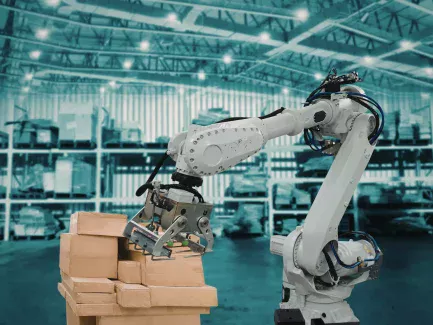
Automated systems also optimise warehouse space by efficiently organising and retrieving items, which minimises waste and maximises storage capacity. Collaborative robots, or “cobots,” work alongside human employees to enhance operations. They assist with repetitive tasks, allowing workers to focus on more complex duties. This not only improves worker safety by reducing the risk of injury, but it can also increase overall job satisfaction.
Moreover, robotics enables data-driven decision-making through integration with AI and advanced analytics. By collecting real-time information, companies can forecast demand, monitor inventory levels, and adjust supply chains accordingly. This agility helps wholesale distributors better predict market fluctuations, enabling them to provide unique insight to their suppliers and customers.
There’s no doubt that adopting robotics in wholesale distribution reduces operational costs over time. While the initial investment may be substantial, the long-term benefits of increased efficiency, stable labour levels, and enhanced customer satisfaction can make it a game-changer in modern value chains.
Cloud-based systems: Enhancing simplicity and synergy
Meeting ever-increasing customer and supplier demands — in short, consistently providing value and being easy to do business with — requires cloud networks and automation to satisfy today’s expectations.
Cloud ERP and WMS solutions not only position businesses to meet increasingly challenging expectations, but they also help maintain margins and gain a competitive edge. With the ability to integrate the latest technologies, they can also help continuously improve and securely position businesses to be ready for what’s next.
The benefits of Cloud ERP and WMS solutions are many and far-reaching:
Simplifying complex processes
Scalability
Data security and improved disaster recovery
Connectivity between suppliers, warehouses, back-office and logistics teams
Facilitating better stakeholder relationships
Sage Intacct Customer Success Story
National distributor gains greater data insights

The new ERP system is really fantastic, propelling our IT capability 10 years ahead of where it was and making the IT infrastructure fit for the future.
Support knowledge sharing and mentorship
It’s important to encourage mutual respect among workers of all generations. Each generation offers unique skills, experiences, and perspectives. Recognising and valuing these contributions grows a supportive culture where team members help each other succeed.
Clearing the way for knowledge sharing and mentorship programmes is a great way for experienced workers to pass down their expertise to colleagues.
At the same time, younger workers also have the opportunity to share their insights and knowledge.
These programmes can bridge the gap between generations, promoting collaboration and skill development across the board.
Ready to future-proof your business? We’re here to help!
With margins tight and uncertainty here to stay, standing still isn’t an option. The wholesalers and distributors that will thrive are those investing in connected systems, intelligent forecasting, automation, and cloud-based platforms that unlock visibility, efficiency, and resilience.
Talk to our team today to discover how we can help you reduce costs, increase accuracy, and build a distribution operation that’s ready for whatever comes next.